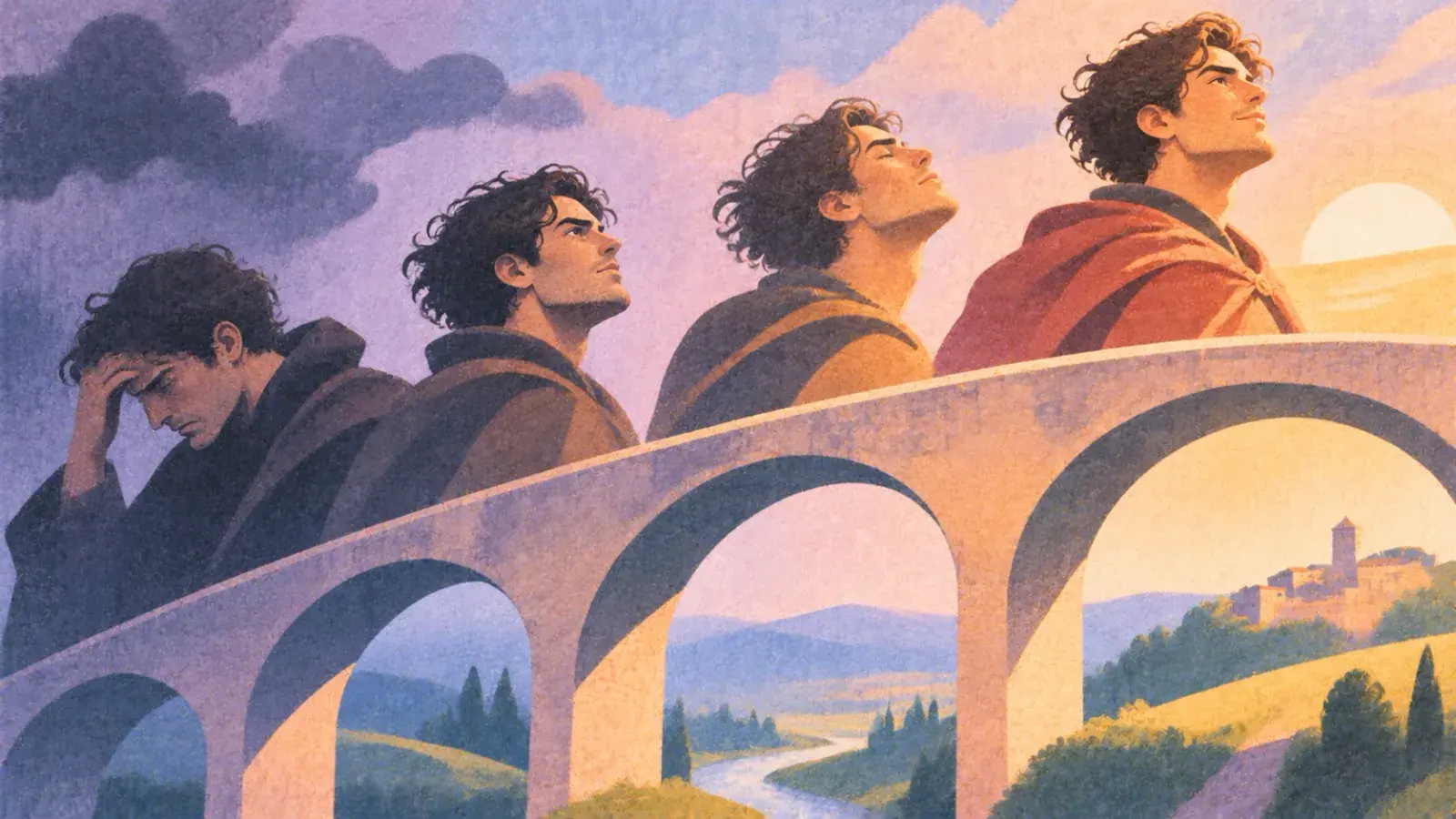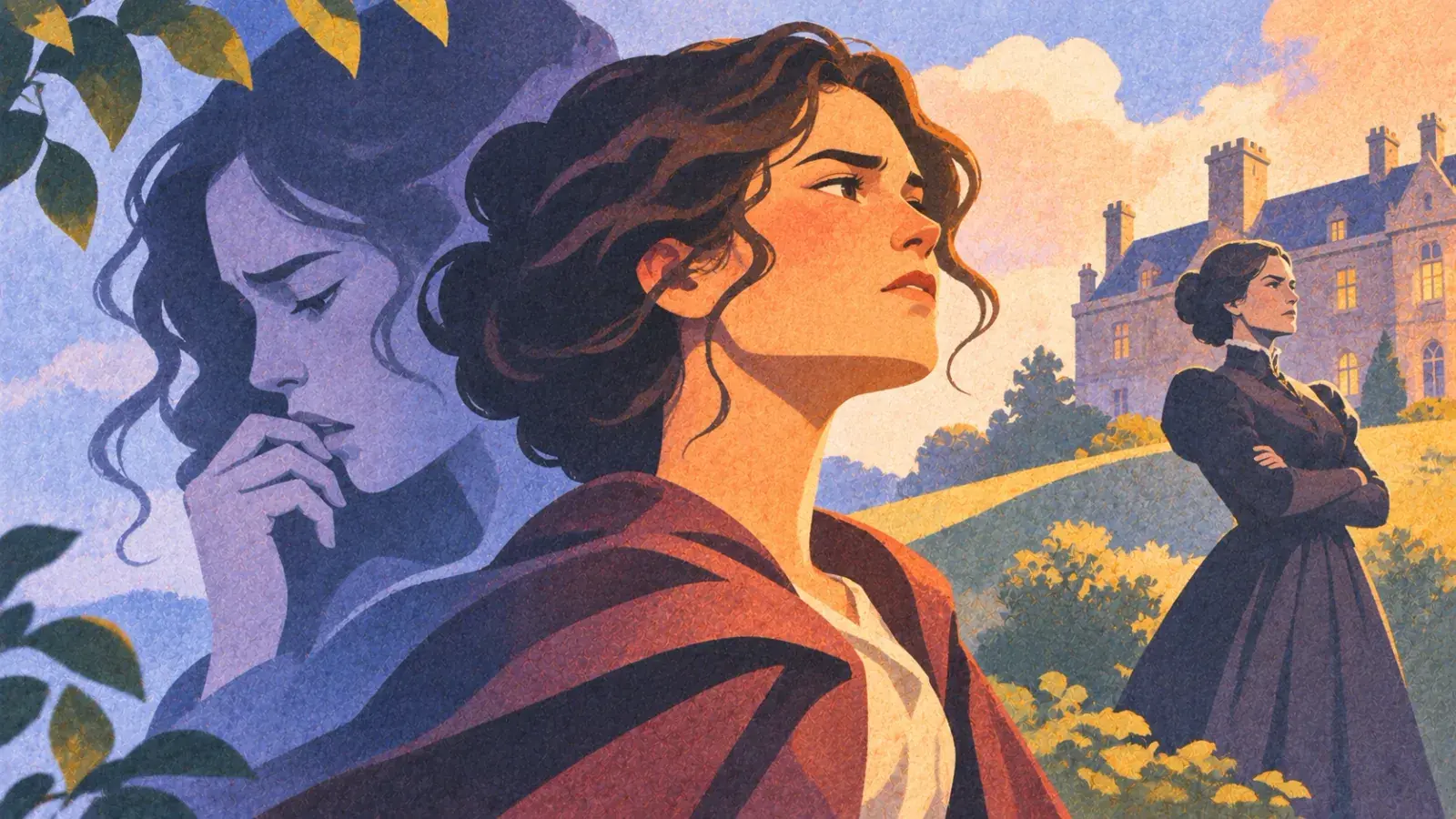
Internal conflict is a struggle inside a character's mind: two desires, or a desire and a belief, pulling against each other. External conflict is a struggle with something outside the character: another person, society, nature, technology, the supernatural or fate. The memory trick is in the words: internal is in the head, external is out in the world. If a camera could film the opponent, the conflict is external; if only the character can feel it, it is internal.
The last ferry leaves in ten minutes. Mara can make it if she leaves her brother behind.
The ferry is the external pressure. Deciding whether to leave him is the internal conflict. The hinge is that decision: the timetable only becomes inner pressure because catching the boat now means choosing against her brother. Take the choice away, and the scene is a race against a clock.
Most novels use both. The external conflict supplies the events, and the internal one gives them their meaning. Huck Finn's trip down the Mississippi is an adventure because of the river and the slave-catchers. It is a great book because of the fight inside Huck.
The difference at a glance
| Internal conflict | External conflict | |
|---|---|---|
| Where it happens | Internal conflictInside one mind | External conflictBetween the character and something outside |
| The opponent | Internal conflictA fear, a desire, a belief, guilt, a loyalty | External conflictA person, a group, a law, nature, a machine, fate |
| How it shows | Internal conflictHesitation, contradiction, choices under pressure, what goes unsaid | External conflictAction, argument, pursuit, obstacles, danger |
| The reader asks | Internal conflictWhat will they choose? | External conflictWill they win, survive or get away? |
| How it ends | Internal conflictA decision, a change of belief, or a refusal to change | External conflictA victory, a defeat, an escape or a truce |
The six external kinds, each with its own examples, are in the guide to the seven types of conflict. This page pairs them with what happens inside the character.
10 internal conflict examples
- Hamlet (William Shakespeare, c. 1600): the duty to avenge his father against doubt, conscience and a disgust with life.
- Macbeth (Shakespeare, c. 1606): ambition against conscience and loyalty to the king he means to kill.
- Jane Eyre (Charlotte Brontë, 1847): her love for Rochester against her self-respect, once she learns he is married.
- Juliet in Romeo and Juliet (c. 1595): love for a Montague against her family: “My only love sprung from my only hate!”
- Arthur Dimmesdale in The Scarlet Letter (Nathaniel Hawthorne, 1850): the need to confess against the fear of losing his name and his congregation.
- Raskolnikov in Crime and Punishment (Fyodor Dostoevsky, 1866): his theory that an extraordinary man may kill against a conscience that gives him no rest.
- Starbuck in Moby-Dick (Herman Melville, 1851): loyalty to his captain against the lives of the crew.
- Edna Pontellier in The Awakening (Kate Chopin, 1899): the self she is discovering against her life as a wife and mother.
- Brutus in Julius Caesar (Shakespeare, 1599): love for his friend against fear for the Republic.
- Michael Corleone in The Godfather (Mario Puzo, 1969): his plan to live outside the family business against loyalty to his father.
I care for myself. The more solitary, the more friendless, the more unsustained I am, the more I will respect myself. I will keep the law given by God; sanctioned by man.
Just before this, her feelings ask, “Who in the world cares for you?” Brontë stages the conflict as a dialogue between two parts of Jane, and the answer is a decision the reader sees carried out: before dawn she leaves Thornfield with almost nothing.
But shall this crazed old man be tamely suffered to drag a whole ship's company down to doom with him?
Starbuck stands outside Ahab's cabin with a loaded musket against the door, asking himself “Shall I? shall I?” Then Ahab cries out in his sleep about the whale, and Starbuck puts the musket back in its rack. His loyalty wins, and the whole crew but one pays for it.
10 external conflict examples
- The Odyssey (Homer): Odysseus against Poseidon's anger at sea and, at home, the suitors who have taken over his house.
- Antigone (Sophocles, c. 441 BC): Antigone against King Creon's decree that her brother's body stay unburied.
- Robinson Crusoe (Daniel Defoe, 1719): a castaway against the island, its storms and his hunger.
- “The Pit and the Pendulum” (Edgar Allan Poe, 1842): a prisoner of the Inquisition against a blade that swings lower every minute.
- Les Misérables (Victor Hugo, 1862): Jean Valjean against Inspector Javert, who hunts him for years.
- The War of the Worlds (H. G. Wells, 1898): the narrator against Martian invaders, on his way back to his wife.
- The Wonderful Wizard of Oz (L. Frank Baum, 1900): Dorothy against the Wicked Witch of the West, on her way home to Kansas.
- The Call of the Wild (Jack London, 1903): Buck against the men, dogs and cold of the Klondike.
- “The Most Dangerous Game” (Richard Connell, 1924): Rainsford against General Zaroff, who hunts men for sport.
- Jaws (Peter Benchley's 1974 novel, and the 1975 film): Brody against the shark, and against a mayor who wants the beaches open.
Down—certainly, relentlessly down! It vibrated within three inches of my bosom!
Poe's narrator has almost no inner conflict. He wants to live, and everything against him is outside: the blade, the pit, the walls. A short story can run on external pressure alone. In a novel, readers start asking what the danger means to the person in it.
How the two drive each other
The strongest stories link the two conflicts so that each one forces the other forward. Outside pressure brings the inner choice into the open. The inner choice then decides how the character takes on the outside world. One of the best-known examples in American fiction comes in Chapter 31 of Adventures of Huckleberry Finn.
I was a-trembling, because I'd got to decide, forever, betwixt two things, and I knowed it. I studied a minute, sort of holding my breath, and then says to myself: “All right, then, I'll go to hell”—and tore it up.
Jim has been sold to a farm downriver, and Huck has written a letter that would send him back to his owner. That external crisis forces the internal one, between the conscience a slaveholding town gave him and his friendship with Jim, to a decision. The decision commits him to the external conflict for the rest of the book: “for a starter I would go to work and steal Jim out of slavery again.”
The connection also decides how a story can end, because the two conflicts don't have to come out the same way:
| Outside | Inside | Example |
|---|---|---|
| OutsideWins | InsideWins | ExampleJane Eyre returns to Rochester when she is free to, on her own terms |
| OutsideLoses | InsideWins | ExampleSydney Carton dies on the guillotine in another man's place: “It is a far, far better thing that I do, than I have ever done” |
| OutsideWins | InsideLoses | ExampleMacbeth gets the crown and loses all peace: “Macbeth does murder sleep” |
| OutsideLoses | InsideLoses | ExampleAhab almost turns back when Starbuck pleads with him in “The Symphony,” then hunts the whale to his death |
The mixed endings are often the most memorable, because they force the reader to weigh one result against the other. Whichever you choose, let one climactic act settle both conflicts if you can, so the character's inner change and the outer outcome land together. How the inner side changes over a book is the subject of the guide to the character arc.
Writing both into one scene
Internal conflict goes wrong when it lives only in summary or in long stretches of thought, and external conflict goes wrong when it never touches anything inside the character. The fix for both is the same: put them in one scene and let the outside events press on the inside.
The jury had been out for six hours when the clerk came for Tom Reyes. In the corridor his client's mother caught his sleeve. “You'll get him off,” she said, not asking. Reyes had found the second receipt that morning, the one that put her son at the warehouse. It was in his inside pocket, and he felt its corner every time he moved. “We'll see what they say,” he told her, and went in without looking back.
The external conflict is the verdict and the mother's demand. The internal one is never named: his duty to his client against what he now knows. It shows in the receipt he can feel, the answer that isn't one and the look he won't give her.
Ways to put inner conflict on the page:
- A choice under pressure, with a cost either way.
- A hesitation or a false start: the hand on the door, the call not made.
- Saying one thing and doing another.
- An object that carries the conflict, like the receipt.
- A thought cut off before it finishes, best in close third or first person (see POV).
On a full draft, ask the Strokes Assistant, with the chapters attached, where the protagonist's inner conflict shows up in a choice or an action and where it is only explained.
Practice: internal or external?
Decide which kind drives each line. Some carry both, and the answers explain the borderline ones.
- A cave diver's air runs low in a flooded passage.
- A nurse who reported a colleague wonders whether she did it for the patients or for the promotion.
- A town council bans the bookshop's window display.
- A pianist freezes whenever her father is in the audience.
- A soldier ordered to fire on protesters lowers his rifle.
Frequently asked questions
Can a conflict be both internal and external?
One situation often carries both. A soldier ordered to fire on protesters faces an external conflict, the order and the officer giving it, and an internal one, obedience against conscience. Writers usually build scenes this way on purpose, so the outer pressure forces the inner choice and the choice changes the outer conflict.
Is man vs. self internal or external?
Internal. Man vs. self, now usually called character vs. self, is the name for internal conflict: the opponent is the character's own fear, guilt, desire or belief. All the other types, against another person, society, nature, technology, the supernatural or fate, are external, because the opposing force is outside the character.
Which is more important, internal or external conflict?
Neither on its own. External conflict creates the events and the suspense; internal conflict makes readers care how they turn out. Thrillers lean external and literary fiction leans internal, but most memorable books tie the two together, so that the climax settles the outer struggle and the inner one at the same moment.