An email sign-off is the word or short phrase between your last sentence and your name: Best, Thanks, Kind regards. For most work email, Best or Thanks is safe. Best regards and Kind regards are a step more formal, Sincerely belongs on cover letters and formal letters, and in a fast-moving thread you can drop the sign-off and just type your name.
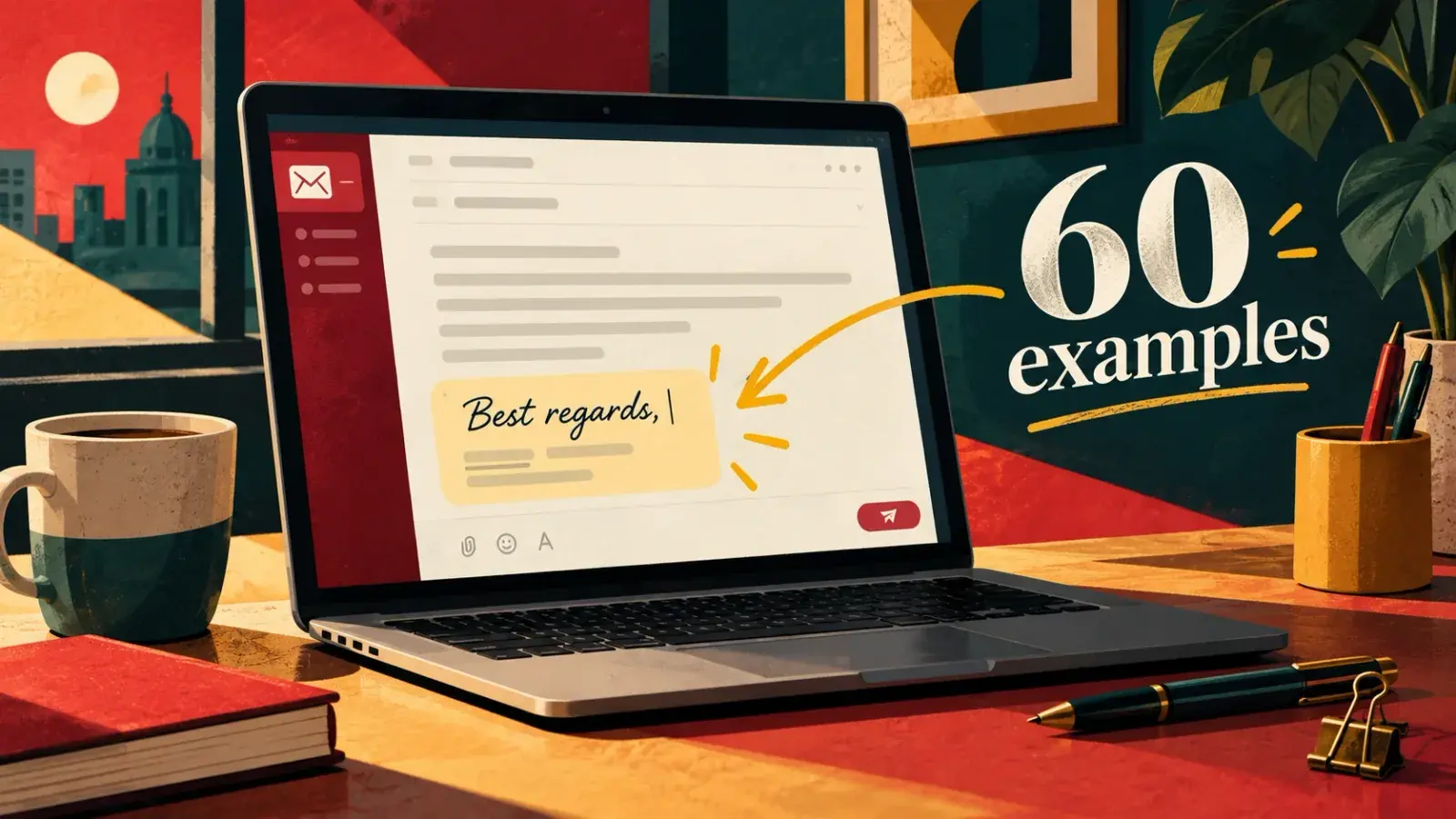
The right choice depends on three things: how you opened the email, whether you are asking for something, and how well you know the reader. Below are 60 sign-offs grouped by situation, each with a note on when it fits, followed by sample endings, the ones to avoid and the formatting rules. The people and emails in the examples are invented.
Pick a sign-off in five seconds
If you only need an answer for the email in front of you, start here. The rest of the page explains the choices and gives you alternatives.
| Situation | Safe choice | Also fine |
|---|---|---|
| SituationFirst email to someone new | Safe choiceBest regards | Also fineKind regards |
| SituationEveryday work email | Safe choiceBest | Also fineThanks, All the best |
| SituationYou are asking for something | Safe choiceThanks | Also fineThank you, Many thanks |
| SituationCover letter or formal letter (US) | Safe choiceSincerely | Also fineRespectfully |
| SituationFormal letter (UK), named reader | Safe choiceYours sincerely | Also fineKind regards |
| SituationFormal letter (UK), “Dear Sir or Madam” | Safe choiceYours faithfully | Also fineRarely anything else |
| SituationClose colleague or teammate | Safe choiceThanks | Also fineCheers, Talk soon |
| SituationQuick reply in a thread | Safe choiceYour first name | Also fineNothing at all |
| SituationBad news or condolences | Safe choiceTake care | Also fineWith sympathy |
Professional sign-offs for everyday email
Most work email needs one of the sign-offs in this section. They are neutral, short and safe with a manager, a client or someone in another time zone. If you learn one group, learn the first.
Neutral sign-offs
- Best. The default for most work email. It reads the same to a colleague and a stranger and suits good news and routine alike. A few readers find it curt, so give the email a friendly last line.
- Best regards. Best with a little more ceremony. Use it for first contact, clients, vendors and anyone you would address by last name.
- Kind regards. The same weight as Best regards, slightly warmer, and just as safe.
- Regards. Neutral to cool. Fine on a routine handoff. On a tense thread it can read as clipped, so pick something warmer there.
- All the best. Friendly and hard to misread. Good when you don't expect to write again soon, such as after a one-off favor.
- Best wishes. Warm and a little traditional. Suits the end of a project or a goodbye to a client.
- Warm regards. A formal shape with a friendlier tone, for clients and contacts you have met or spoken with.
The revised layout is in the shared folder, and the printer has confirmed Tuesday delivery. I'll send proofs of the cover by the end of Thursday.
Best regards,
Nadia Okafor
Thank-you sign-offs for requests
If the email asks for something, a thank-you is the natural close: it acknowledges the reader's time and works as a polite nudge. Just don't thank twice. If your last sentence already says “Thanks for looking at this,” sign off with Best.
- Thanks. The most useful sign-off in work email. It fits any request, small or large, with almost anyone.
- Thank you. A shade more formal than Thanks. Use it with senior people, new contacts and customers.
- Many thanks. Warm and a little formal. Good when the reader has already helped or is about to do real work for you.
- Thanks so much. For a favor that costs the reader something: a rush review, a reply over the weekend.
- Thanks in advance. Fine for routine requests, like sending a file when they have a minute. For a big favor it assumes the answer is yes; write “Thank you for considering this” instead.
- Thanks again. When you have already thanked them, in an earlier email or in person: after a meeting, an interview or a call.
- Much appreciated. Brisk and friendly. Right for a colleague who helps often, a bit abrupt for a stranger.
- With thanks. Formal and calm. Works on letters and on emails to people who have done you a real favor.
Could you send me the third-quarter totals for the Midwest stores by Wednesday? I only need the totals, not the store-by-store breakdown.
Thanks,
Owen
Do thank-you sign-offs get more replies?
Boomerang, which makes an email scheduling plug-in, tested this in 2017. It looked at more than 350,000 email threads from the mailing-list archives of over twenty online communities and compared reply rates by closing. Closings that thanked the reader came out ahead.
| Closing | Reply rate |
|---|---|
| ClosingThanks in advance | Reply rate65.7% |
| ClosingThanks | Reply rate63.0% |
| ClosingThank you | Reply rate57.9% |
| ClosingCheers | Reply rate54.4% |
| ClosingKind regards | Reply rate53.9% |
| ClosingRegards | Reply rate53.5% |
| ClosingBest regards | Reply rate52.9% |
| ClosingBest | Reply rate51.2% |
| ClosingAll emails in the sample | Reply rate47.5% |
Read it with care. Mailing lists are not office inboxes, and an email that ends in thanks is often one that asks a question, which is more likely to get an answer whatever the sign-off. The numbers show a pattern, not proof that swapping Best for Thanks will win you replies. The useful lesson is smaller: when you are asking for something, a thank-you close is natural and does no harm.
Sign-offs that set up the next step
These end the email by pointing at what happens next. Use them when there is a real next step, and make sure the body already says what it is. A sign-off can't carry a deadline on its own.
- Looking forward to hearing from you. Polite, formal, and a gentle prompt for a reply. Standard after a proposal or an application follow-up.
- Looking forward to your thoughts. For a draft, a plan or anything else you want feedback on.
- Talk soon. Friendly, and it implies you will be in touch shortly. Use it only if you will.
- Talk Thursday. Or whatever day the call is. It confirms the meeting without another sentence.
- See you then. After the email has set a time and a place.
- Happy to help. When you have answered a question and want the reader to know more questions are welcome.
- Let me know if you have any questions. Common and a little worn. Keep it for emails that send instructions or a document; drop it after a two-line update.
Thursday at 10 a.m. Pacific works. I'll send a calendar invite with the link and have the budget numbers ready by then.
Talk Thursday,
Jun
Formal sign-offs
Formal sign-offs belong on emails that work like letters: cover letters, applications, messages to officials, legal or financial correspondence, and anything that opens with “Dear.”
Letters and cover letters
In American English, Sincerely is the standard. British English splits the formal close in two, depending on whether you know the reader's name.
- Sincerely. The standard close for an American cover letter or formal letter. In a casual email it reads stiff.
- Sincerely yours. The longer, older form. It does the same job as Sincerely.
- Yours sincerely. British usage, when you address the reader by name (Dear Ms. Patel).
- Yours faithfully. British usage, when you don't know the name and open with Dear Sir or Madam.
- Yours truly. Formal and old-fashioned. Sincerely does the same work and looks less dated.
- Respectfully. For a judge, an elected official or a formal request to someone with authority over the outcome. In an ordinary disagreement it can sound frosty.
- Very respectfully. US military email to someone senior in rank. Writing to someone junior, the custom is Respectfully.
- With kind regards. A formal Kind regards. At home on a letter attached as a PDF or an email to a senior stranger.
Thank you for considering my application. I would welcome the chance to talk about how my five years of grant reporting could support the foundation's new literacy program.
Sincerely,
Marisol Vega
(312) 555-0142
Sincerely is the safe close for a cover letter in any field, and it is the one the cover letter template uses.
Pitches, applications and query letters
When the email asks a stranger to read something, the close usually thanks them for their time. These phrases often stand in for the sign-off itself, directly above your name.
- Thank you for your consideration. Standard on job applications, grant requests and proposals.
- Thank you for your time and consideration. A common close for query letters to literary agents and pitches to editors, often followed by Best regards.
- Thanks for reading. For a cold pitch to a busy editor or producer. Short and honest about what you are asking for: their attention.
- Thanks for taking a look. The lighter version, for a follow-up, a portfolio link or a draft sent to a contact.
The piece would run about 1,800 words and could be ready three weeks after you say yes. I've attached two clips from the past year.
Thanks for reading,
Theo Lindqvist
For a query, the agent's submission guidelines matter far more than the last line. The guide to writing a query letter covers the parts that come before it.
Friendly and casual sign-offs
Once you know the reader, the sign-off can warm up. Go one step at a time: from Best to Warm regards before Cheers, and only as far as the other person has gone.
Warm sign-offs for people you know
For a client you have worked with for years, a former colleague or a mentor: warmer than Best, and still fine if the email gets forwarded.
- Warmly. Friendly and sincere without being personal.
- Warm wishes. A little more personal. Good for a holiday note or a reply to someone's good news.
- With gratitude. For real thanks: a reference letter, a long favor, advice that changed a decision.
- All my best. A softer All the best, for someone you are fond of.
- Hope to see you soon. When a meeting is likely but not yet scheduled.
- Be well. Calm and kind. Good for an email that ends a working relationship on good terms.
Casual sign-offs for teammates
Inside a team the sign-off often shrinks to almost nothing, and that's fine. Mirror what your colleagues do.
- Cheers. An informal goodbye or thanks in British, Australian and other Commonwealth English, and an everyday email sign-off there. In American email it reads as casual, so keep it for people you know.
- Thanks! The exclamation point makes it friendlier. Fine for teammates, too bright for a formal request.
- Talk later. For someone you will see or message again the same day.
- Have a good one. Relaxed. Fine for a vendor or a colleague you know.
- Your first name. No sign-off, just the name. Normal from the second message in a thread.
- Your initial. One letter, for colleagues who know you well and threads that move fast.
- A dash and your name. —Sam. Halfway between a sign-off and none. An em dash or a plain hyphen both work.
Done, the new header is live on staging. Shout if the spacing looks off on mobile.
—R
Weekends, holidays and occasions
A sign-off tied to the calendar makes a routine email sound like a person wrote it. Check the reader's time zone first: “Have a good evening” lands oddly at their 7 a.m., and work weeks differ by country.
- Have a great weekend. Sent on a Thursday afternoon or a Friday. One of the safest friendly closes.
- Enjoy the weekend. The same job, a little lighter.
- Have a good evening. For an email that arrives late in the reader's day.
- Happy Friday. Cheerful. Save it for people whose Friday matches yours, not a client working through the weekend.
- Safe travels. When the reader is about to fly or drive somewhere, especially for you.
- Enjoy your time off. For someone about to go on leave. If you're the one leaving, these out-of-office message examples cover the auto-reply.
- Happy holidays. The inclusive choice for late December. Use the specific greeting when you know what the reader celebrates.
- Congratulations again. After a promotion, a launch or a book deal, when the body has already said it once.
Sign-offs for sensitive emails
Condolences, bad news and apologies need a sign-off that matches the body. A breezy Cheers under an apology undoes the apology.
- With sympathy. For a condolence email to a colleague or client. Simple and sincere.
- Thinking of you. Warmer, for someone you know personally.
- Take care. For an email that delivers bad news, ends a working relationship or reaches someone in a hard stretch.
- With apologies. After a real mistake, once the body has explained what happened and what you are doing about it.
- Please let me know how I can help. For a colleague dealing with illness, a loss or a crisis, when you mean the offer.
I was so sorry to hear about your father. Please don't worry about the review this week. Priya and I have it covered.
Thinking of you,
Ellen
Sign-offs to avoid at work
None of these is a disaster. Each one just says something you probably didn't mean, and a better option costs nothing.
| Sign-off | The problem | Try instead |
|---|---|---|
| Sign-offThx, Rgds, BR | The problemAbbreviations look rushed, and BR is opaque to many readers | Try insteadThanks, Regards, Best regards |
| Sign-offSent from my iPhone, alone | The problemSays you didn't choose a sign-off; fine for quick replies only | Try insteadBest, and your name |
| Sign-offLove, xo, Hugs | The problemToo personal for most workplaces | Try insteadWarmly |
| Sign-offYours | The problemReads like a fragment of a longer close | Try insteadYours sincerely, or Best |
| Sign-offRespectfully, in an argument | The problemCan sound pointed in an ordinary disagreement | Try insteadThanks |
| Sign-offBest, under a complaint | The problemFeels cold after something went wrong | Try insteadThanks for looking into this |
| Sign-offBlessings | The problemReligious; fine only if you know the reader shares it | Try insteadWarm wishes |
| Sign-offLater, Peace | The problemToo offhand for anyone outside your team | Try insteadTalk soon |
How to choose and format a sign-off
Sixty options are only useful if you can pick one quickly. Four checks cover almost every email.
- Match the greeting
“Dear” calls for Sincerely or Best regards. “Hi” goes with Best or Thanks. “Hey,” or no greeting, goes with a casual close or just your name. A sign-off much more formal than the greeting reads stiff; one much less formal reads careless.
- Check what the email asks
A request ends with some form of thanks. An update ends with Best. Bad news ends with Take care or another warm close. Thank the reader once, in the last line or the sign-off, not both.
- Follow the reader's lead
After the first exchange, match the other person's level and don't go below it. If a client starts signing “Sam,” you can drop to Best and your first name. If they still write Kind regards, stay there.
- Read the last two lines together
Readers take the closing sentence and the sign-off as one unit. “Let me know if you need anything else. Cheers,” works. “I'm sorry for the delay. Cheers,” does not. For the sentence that comes before the sign-off, see how to end an email.
Formatting the close
The conventions come from business letters and carry over to email almost unchanged.
- Capitalize only the first word: Best regards, not Best Regards.
- Put a comma after it. The exception is open punctuation, where neither the greeting nor the sign-off has any. Pick one style and use it at both ends.
- Put your name on the next line, with no blank line in between.
- Keep the signature to three or four lines: name, title and organization, one phone number or link. If your company's style guide sets a signature format, follow it.
- Leave the sign-off out of your saved signature. If the mail app adds “Best regards” automatically, you will send it under condolences and one-word replies alike. Type it each time.
Best regards,
Dana Whitfield
Managing Editor, Larchmont Review
(617) 555-0178
Sign-offs in other languages
When you write a whole email in another language, use that language's close rather than translating an English one. These are the standard business closings in German, French and Spanish.
| Language | Standard close | Notes |
|---|---|---|
| LanguageGerman | Standard closeMit freundlichen Grüßen | NotesNo comma after it. Friendlier: Viele Grüße, Beste Grüße |
| LanguageFrench | Standard closeCordialement | NotesThe everyday polite close, close to Regards |
| LanguageSpanish | Standard closeAtentamente | NotesPolite and formal; Cordialmente is a common alternative |
Drafting the emails that matter
Most sign-offs take a second. The ones that take longer come at the end of emails you shouldn't write in a reply box: a resignation, an apology to a client, a pitch to an editor you admire. Draft those in a document, where you can come back and read them cold before you send.
In Strokes, select the last paragraph and the sign-off, press ⌘K and ask for a warmer version, a more formal one or one without the exclamation point. The rewrite happens in place, and version history keeps the draft you started with. The AI Assistant beside the document can read the whole email and tell you whether the close matches the tone of everything above it. Then copy the finished text into your mail app.
Frequently asked questions
What is the most professional email sign-off?
Best regards and Kind regards are the safest choices for professional email to someone you don't know well. For a cover letter or formal letter in the US, use Sincerely. Thank you works whenever the email asks for something.
Is it rude to sign off with Best?
No. Best is a standard neutral sign-off in work email, and most readers don't register it at all. A few find it curt, so on a delicate email choose Thanks or Warm regards instead.
Should there be a comma after an email sign-off?
Yes: Best regards, then your name on the next line. Capitalize only the first word. Some writers use open punctuation, with no comma after the greeting or the sign-off; that is fine as long as both ends match. German closings take no comma.
Is Thanks in advance rude?
Not for routine requests. For a large favor it can read as assuming the answer is yes. Thank you for considering this, or a plain Thanks, avoids that.
Do I need a sign-off on every reply?
No. In a quick back-and-forth most people drop the sign-off after the first message or two and sign with a first name or nothing. Go back to a full sign-off when the audience changes, for example when you forward the thread to someone new.