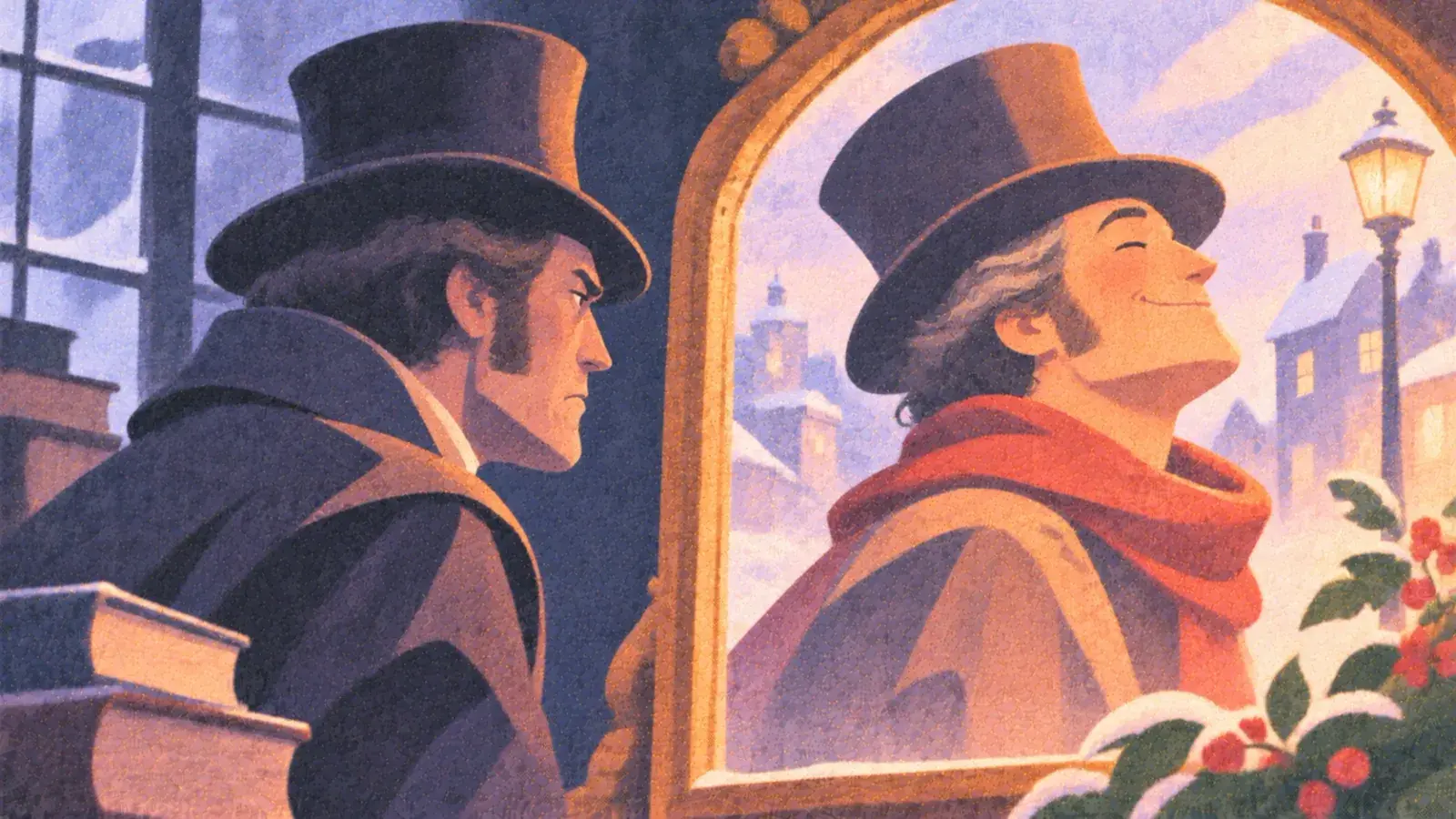
A dynamic character is a character who goes through a significant, lasting inner change over the course of a story: in their personality, beliefs, values or the way they see themselves. Ebenezer Scrooge is the textbook case, a miser on Christmas Eve who by the end of A Christmas Carol (1843) has become “as good a friend, as good a master, and as good a man, as the good old city knew.” The opposite is a static character, who finishes a story as the same person who started it.
Most protagonists are dynamic, and so are some memorable supporting characters. What earns the label is the kind of change, not the amount of plot. Below: what counts as change, twelve examples, how dynamic differs from round, and how to write a change readers believe.
What counts as a dynamic change
A change makes a character dynamic when it is:
- Internal. It happens in the person, not the situation. Money, marriage or prison change a life, and change the character only if they change what the character believes.
- Significant. A new view of themselves, of another person, or of right and wrong. Not a new opinion about dinner.
- Lasting. It holds after the scene that caused it. Remorse that soon fades, as Mr. Bennet predicts his will in Pride and Prejudice, leaves a character static.
- Caused. Something in the story produces it, so the reader can trace it back.
Direction doesn't matter. A character who gets worse is as dynamic as one who gets better. Change also comes in several kinds, and many characters go through more than one:
| Kind of change | What shifts | Example |
|---|---|---|
| Kind of changeMoral improvement | What shiftsValues, and how they treat people | ExampleScrooge, A Christmas Carol (1843) |
| Kind of changeMoral decline | What shiftsValues, until nothing restrains them | ExampleMacbeth, Macbeth (c. 1606) |
| Kind of changeSelf-knowledge | What shiftsHow they see themselves | ExampleEmma Woodhouse, Emma (1815) |
| Kind of changeA new judgment of someone | What shiftsWhat they believe about another person | ExamplePip about Magwitch, Great Expectations (1861) |
| Kind of changeBreaking with what they were taught | What shiftsBeliefs absorbed from family or society | ExampleHuck, Adventures of Huckleberry Finn (1884) |
| Kind of changeDisillusionment | What shiftsFaith in a dream or an ideal | ExampleThe boy in James Joyce's “Araby” (1914) |
| Kind of changeOpening up | What shiftsTheir capacity for affection | ExampleMary Lennox, The Secret Garden (1911) |
Dynamic character examples
There was a boy singing a Christmas Carol at my door last night. I should like to have given him something: that's all.
I am not the man I was. I will not be the man I must have been but for this intercourse.
The first crack is tiny. The first spirit has just shown Scrooge the boy he was, left alone at school over Christmas, and he finds himself wishing he hadn't chased a carol singer from his keyhole. Big changes are easier to believe when they start this small.
The proof is a matched pair of choices under the same pressure. In Stave 1 his nephew Fred invites him to Christmas dinner, and Scrooge sends him off with “Good afternoon!” Fred, the static character beside him, keeps the offer open: “I mean to give him the same chance every year, whether he likes it or not, for I pity him.” In Stave 5 Scrooge walks to Fred's house himself: “I have come to dinner. Will you let me in, Fred?” Same invitation, same holiday, opposite answer. The character arc guide follows the rest of the change stave by stave.
Which of you shall we say doth love us most?
I am a very foolish fond old man,
Fourscore and upward, not an hour more nor less;
The king who staged a contest for his daughters' love ends asking the one he banished to “forget and forgive: I am old and foolish.” The change costs him his kingdom and his reason, and the play doesn't let him keep the reward: in the last scene he carries Cordelia in dead.
For now, my repugnance to him had all melted away […] I only saw in him a much better man than I had been to Joe.
The convict whose money made Pip a gentleman has been taken after a failed escape down the river, and Pip, who once shrank from him, holds his hand. The change is a new judgment of another person, and it carries a judgment of himself: the second sentence measures the distance against Joe, the static character Pip failed.
I have been a selfish being all my life, in practice, though not in principle. […] By you, I was properly humbled.
Darcy changes too, and Austen shows it in what he does. His first proposal insults her family. Before his second, he has been civil to her aunt and uncle at Pemberley and quietly paid for Lydia's marriage.
When Mary Lennox was sent to Misselthwaite Manor to live with her uncle everybody said she was the most disagreeable-looking child ever seen.
She had begun to like the garden just as she had begun to like the robin and Dickon and Martha's mother.
Burnett makes the change gradual and physical: cold wind, digging, a robin, a locked garden, a maid who talks to her as an equal. “Begun to like” is the key phrase. For a sour, neglected child, liking things is the first new habit, and the rest of the book builds on it.
| Character | Starts | Ends | What changes them |
|---|---|---|---|
| CharacterEmma Woodhouse, Emma | StartsSure she understands everyone's heart | EndsSees her own vanity | What changes themInsulting Miss Bates at Box Hill, and Mr. Knightley's rebuke |
| CharacterHuck, Huckleberry Finn | StartsBelieves helping Jim escape is a sin | EndsDecides he would rather go to hell than betray Jim | What changes themWeeks on the raft with Jim |
| CharacterMacbeth, Macbeth | StartsA loyal, praised general | EndsA tyrant who can no longer feel fear | What changes themThe witches, his wife and his own ambition |
| CharacterJean Valjean, Les Misérables (1862) | StartsA hardened ex-convict | EndsA man who lives for others | What changes themA bishop's mercy over stolen silver |
| CharacterSilas Marner, Silas Marner (1861) | StartsA miser who loves his gold | EndsA devoted father | What changes themHis gold is stolen; a toddler wanders in from the snow |
| CharacterDorian Gray, The Picture of Dorian Gray (1890) | StartsAn innocent young man | EndsA corrupt one | What changes themA wish that his portrait would age instead of him |
Dynamic vs static characters
| Dynamic | Static | |
|---|---|---|
| What changes | DynamicTheir beliefs, values or view of themselves, for good | StaticTheir circumstances, what they know, their mood; not the person |
| What the reader watches | DynamicHow and why they change | StaticHow they hold up under pressure |
| Usual roles | DynamicProtagonists, love interests, some villains | StaticSupporting cast, series leads, comic figures, many villains |
| In A Christmas Carol | DynamicScrooge | StaticFred, his nephew |
Most stories pair the two. A static character beside a dynamic one shows the distance traveled: Fred beside Scrooge, Joe Gargery beside Pip. The reader measures the change against whoever stayed put, which is why the static foil is such an old device. The static character guide covers that side, including characters who are offered a change and refuse it.
Dynamic doesn't mean round
Change and complexity are separate scales. E. M. Forster's flat and round, from Aspects of the Novel (1927), measure complexity: a flat character is “constructed round a single idea or quality,” a round one is “capable of surprising in a convincing way.” Put two characters side by side and the scales come apart. The prodigal son in Luke's parable changes completely and has almost no depth. Mr. Bennet in Pride and Prejudice has depth to spare and doesn't change at all.
And when he came to himself, he said, How many hired servants of my father's have bread enough and to spare, and I perish with hunger!
The parable never gives him a name, a face or a trait beyond his folly, which makes him about as flat as a character can be. What changes is his judgment of himself, and he goes home ready to ask to be made “as one of thy hired servants.” Fables and fairy tales are full of flat characters who change.
How to write a dynamic character
- Write the starting belief as a sentence
Something the character would say on page one and the story will break: “Asking for help is weakness.” Then show it in a choice in their first chapter. The character profile template has a field for the arc from start to end.
- Put each cause on the page
Every stage of the change needs an event the reader sees. Time passing isn't a cause, and neither is the author needing an ending.
- Match the time to the size
Big changes need many scenes, or very heavy pressure: Scrooge changes in one night because three spirits make him watch his whole life. A short story usually holds one change of understanding, as “Araby” does.
- Keep the voice
The changed character is still recognizably the same person. On the day after Christmas, Scrooge pretends to growl at Bob Cratchit for coming in late, then raises his salary. The sharpness survives; it has found a better use.
- Make the change a choice with a cost
Huck believes he is giving up his soul. Darcy swallows his pride and pays off Wickham. A change that costs nothing is hard to believe.
- Echo an early scene
Bring back a situation from the opening and let the character act differently. Scrooge meets one of the gentlemen he turned away in Stave 1 and whispers a donation that leaves the man breathless.
Chapter 3. “I can scrub in,” Tomás said. “You've been on since six.” Ines didn't look up from the scans. “If I need a second pair of hands, I'll ask for one.” She closed at two in the morning, alone, and drove home with the radio off.
Chapter 26. Her hands had started to shake an hour in. Ines held them still over the field and counted to five. “Tomás.” He looked up. “Take the retractor. Then take the rest.” She stepped back from the table, and nobody in the room said anything, which was the kindest thing they could have done.
The second scene works because the first exists: same room, same junior, opposite choice. The change costs her the thing she valued most, being the one who finishes. The chapters between have to earn it, each one making her rule a little more expensive.
Mistakes that make change unbelievable
- The overnight conversion. A belief held for twenty years drops after one conversation. Give the old belief at least two chances to win.
- Change by announcement. The narration says she has changed, and she goes on behaving exactly as before.
- A new person with the old name. The character changes so completely that their voice, humor and habits vanish.
- Everyone changes. With no fixed point, the reader can't measure anyone's movement.
To check a draft for the overnight conversion, ask the Strokes Assistant to list, chapter by chapter, what the character believes at that point. A list that jumps from the old belief to the new one in a single chapter shows you where the change needs another stage.
For planning an arc around want, need and wound, see the character development guide.
Frequently asked questions
Is the protagonist always a dynamic character?
No, though most are. Series detectives such as Sherlock Holmes stay the same from case to case, and some protagonists hold steady while they change the people around them, which writers call a flat arc. A story with a static lead needs its change somewhere else.
What is the difference between a dynamic and a round character?
Dynamic is about change: the character ends the story as a different person. Round, E. M. Forster's term, is about complexity: the character has contradictions and can surprise the reader convincingly. Most protagonists are both, but the scales are separate. The prodigal son changes without being complex, and Mr. Bennet is complex without changing.
Is a character arc the same as a dynamic character?
Not quite. A character arc is the path a character's inner life takes through the story. A dynamic character is one whose arc ends in real change, for better or worse. A flat arc, where the character holds a truth and changes others, belongs to a static character.