An argumentative essay takes a position on a question reasonable people disagree about, supports it with evidence, and answers the strongest objection to it. The last part is what sets it apart. A report explains. A persuasive essay can lean on feeling. An argumentative essay has to show its reasoning and survive the other side’s best case.
Below are original examples, each with notes on what every part is doing: a complete five-paragraph essay, the same argument broken into Toulmin’s terms, a Rogerian essay that argues toward common ground, a timed exam response, thesis statements from weak to strong, and three ways to write a counterargument paragraph. A step-by-step method and an outline follow.
How an argumentative essay is built
Most assignments expect the same four parts, whether the essay runs five paragraphs or fifteen pages. Purdue’s Online Writing Lab suggests that longer essays give one or two full paragraphs to opposing views; in a five-paragraph essay, one body paragraph usually does that job.
| Part | What it does | In a five-paragraph essay |
|---|---|---|
| PartIntroduction | What it doesSets up the question, shows why it matters, states the thesis | In a five-paragraph essayParagraph 1 |
| PartBody paragraphs | What it doesEach makes one claim, backs it with evidence, explains the link | In a five-paragraph essayParagraphs 2–3 |
| PartCounterargument | What it doesStates the best objection fairly, then answers it | In a five-paragraph essayParagraph 4 |
| PartConclusion | What it doesSays what the evidence adds up to and what should happen next | In a five-paragraph essayParagraph 5 |
Inside that frame there are three common ways to arrange an argument. An assignment may name one; if it does not, pick the order that fits your reader.
| Model | Shape | Best for |
|---|---|---|
| ModelClassical | ShapeBackground, your case, the other side refuted, conclusion | Best forA neutral reader who has not made up their mind |
| ModelToulmin | ShapeClaim, grounds, warrant, backing, qualifier, rebuttal | Best forTesting one argument closely; complex or technical topics |
| ModelRogerian | ShapeTheir view and when it holds, your view and when it holds, shared benefits | Best forA reader who disagrees and will stop reading if attacked |
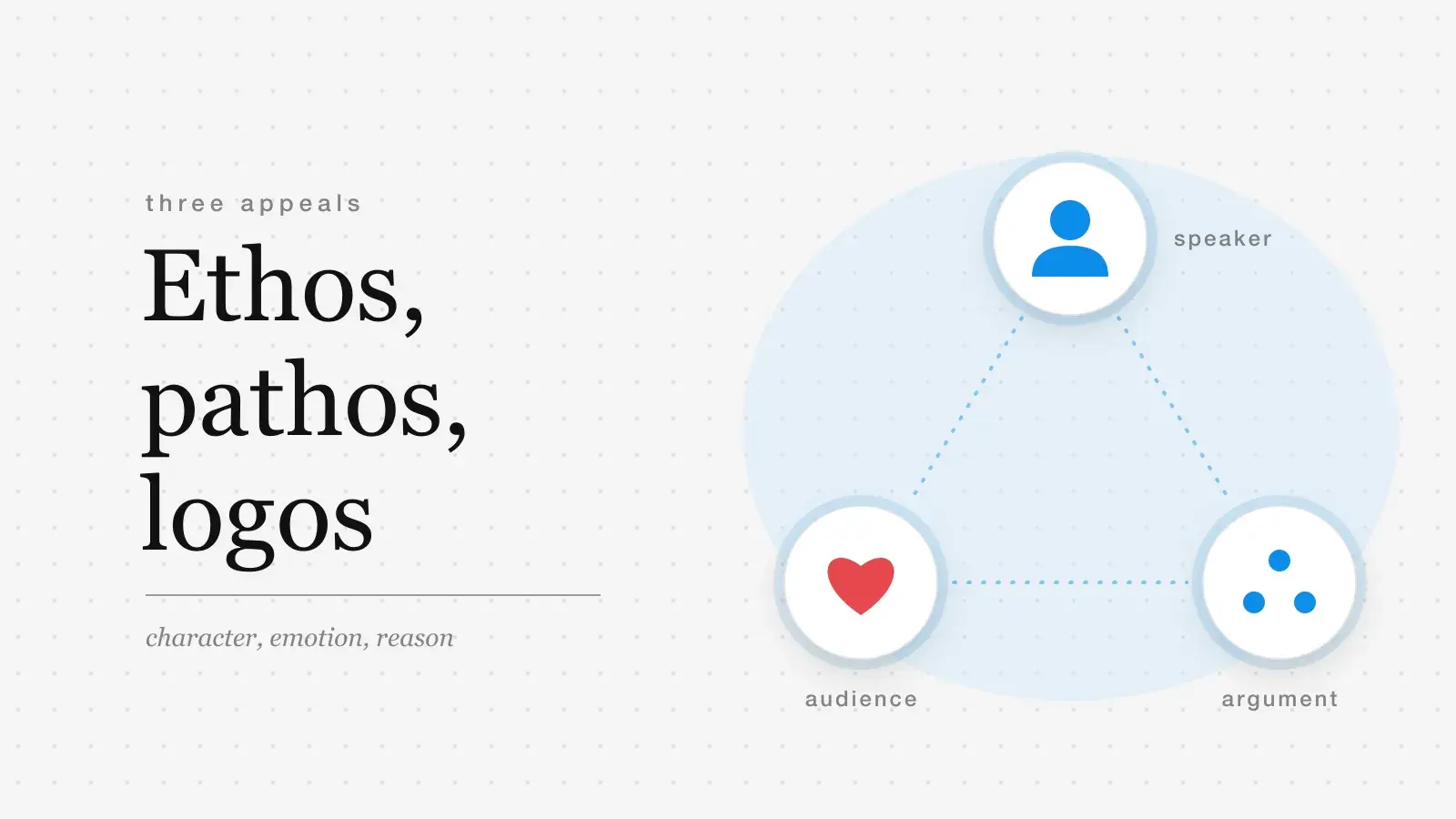
The classical arrangement descends from Greek and Roman oratory, the same tradition that named the appeals to ethos, pathos and logos. An argumentative essay leans on logos, the reasoning and evidence, while still earning trust through a fair, even tone.
Full example: a five-paragraph essay
The prompt: Should high schools start at 8:30 a.m. or later? It makes a good practice topic because the evidence on both sides is public and the stakes are concrete. The essay below is written at a high school level, about 600 words, and its facts and sources are real, so you can look each one up and see how it was used.
Introduction
A sophomore who wakes at 6:15 to catch a 6:50 bus has to be asleep by about 9:45 p.m. to get even eight and a half hours of sleep, the low end of what the American Academy of Pediatrics recommends for teenagers. Most do not manage it. A 2015 report from the Centers for Disease Control and Prevention found that less than a third of U.S. high school students sleep at least eight hours on school nights, and that in the 2011–12 school year the average public middle and high school started at 8:03 a.m. (Wheaton et al.). Since 2014 the pediatricians’ advice has been that these schools start no earlier than 8:30. High schools should follow it, because teenagers cannot simply go to bed earlier, because students really do sleep more when the bell moves, and because the costs of the change are problems of scheduling, not reasons to keep students tired.
Why it works. The hook is a piece of arithmetic the reader can check, not a dictionary definition or a question. Two facts establish the problem, one sentence names the expert position, and the thesis states the claim with three reasons in the order the essay will take them. The third reason already points at the counterargument, so the reader knows the objection will be handled.
Body paragraph 1: the biology
The usual reply is that teenagers should go to bed earlier, but their bodies work against it. During adolescence, the CDC report explains, young people become sleepy later at night and need to sleep later in the morning. That is a change in biology, not a lack of discipline. A fifteen-year-old sent to bed at 9:30 may well lie awake until 10:30, and the alarm still goes off at 6:15. A school day that starts before eight asks students to get up while their bodies are still set for sleep, five days a week, for four years. If the purpose of school is learning, a schedule that guarantees a tired room in first period works against the school’s own goal.
Why it works. The paragraph opens by stating the opposing idea it is about to take apart, then answers it with evidence (paraphrased, with the source named in the sentence) and finishes with reasoning that connects the evidence back to the thesis. That last step is the one most drafts skip.
Body paragraph 2: the evidence that it works
When start times move, students sleep more. For the 2016–17 school year, Seattle moved the first bell at its secondary schools from 7:50 to 8:45 a.m. Researchers at the University of Washington had sophomores at two of its high schools wear wrist activity monitors before and after the change. Median sleep on school days rose by 34 minutes, and the students’ median second-semester grade in biology rose from 77.5 to 82 percent (Dunster et al.). Critics often predict that teenagers will simply stay up later and cancel out the gain, but the 34 minutes is what remained after any later bedtimes. Over a school week, that is nearly three more hours of sleep.
Why it works. The evidence is specific (a place, a change, a measurement method, two numbers), and the method matters: wrist monitors are stronger evidence than students’ own estimates. The paragraph also answers a smaller objection inside itself before the main counterargument arrives.
Body paragraph 3: the counterargument
The strongest objection is practical. In many districts the same buses run several routes each morning, often with high schools first, so a later high school start can mean hiring more drivers or moving younger children to an earlier bell. Later dismissal also pushes back practices, games and after-school jobs. These costs are real, and a school board should count them before it votes. But they are the costs of rearranging a schedule, and districts rearrange schedules for new boundaries, construction and budget cuts without treating the old timetable as fixed. Seattle made the change across a large city district, and in 2019 California became the first state to set a legal limit on how early its middle and high schools may start. Neither change was free. Neither proved impossible. No bus schedule, on the other hand, can give a teenager back four years of short nights.
Why it works. It picks the objection a school board member would actually raise, states it in terms that side would accept, and concedes that the costs are real. The rebuttal does not deny the costs; it reframes them and weighs them against the harm. That is the move readers find most credible.
Conclusion
Schools already accept that a hungry student learns poorly, which is why so many serve breakfast. A tired student learns poorly too, and for most teenagers the cause is a clock the school itself sets. Moving the first bell to 8:30 will not solve every problem with adolescent sleep, and doing it well takes a year of planning. It is still a rare policy that costs no class time and pays back something measurable every morning. Districts should start that planning now.
Why it works. It does not repeat the thesis word for word. It widens the point with a comparison the reader already accepts, admits the limits of the proposal, and ends on a concrete next step.
American Academy of Pediatrics. “School Start Times for Adolescents.” Pediatrics, vol. 134, no. 3, 2014.
Dunster, Gideon P., et al. “Sleepmore in Seattle: Later School Start Times Are Associated with More Sleep and Better Performance in High School Students.” Science Advances, vol. 4, no. 12, 2018.
Wheaton, Anne G., et al. “School Start Times for Middle School and High School Students — United States, 2011–12 School Year.” Morbidity and Mortality Weekly Report, vol. 64, no. 30, 2015.
The same argument in Toulmin’s terms
Toulmin’s model is most useful as a test. Take body paragraph 2 and label each part; anything you cannot fill in is a gap a skeptical reader will find.
| Part | Question it answers | In body paragraph 2 |
|---|---|---|
| PartClaim | Question it answersWhat are you arguing? | In body paragraph 2Later start times give students more sleep |
| PartGrounds | Question it answersWhat is your evidence? | In body paragraph 2Seattle: median sleep up 34 minutes after a 55-minute later start |
| PartWarrant | Question it answersWhy does the evidence prove the claim? | In body paragraph 2A change that worked across a large district is likely to work in similar districts |
| PartBacking | Question it answersWhy trust the warrant? | In body paragraph 2Sleep was measured by wrist monitors, not self-reports |
| PartQualifier | Question it answersHow sure are you? | In body paragraph 2Only implied: 34 minutes is a median, so “students” means most, not all |
| PartRebuttal | Question it answersWhen would it not hold? | In body paragraph 2If students stayed up later; the net gain shows they mostly did not |
Rogerian example: arguing toward common ground
A Rogerian essay is written for a reader who disagrees. Instead of refuting them, it shows you understand their position, grants where it holds, then offers a solution that serves both sides. The example below is a short essay to parents who oppose a high school’s proposal to collect phones during class.
When our school proposed collecting phones at the start of every class, the strongest objection came from parents, and it was not about convenience. Parents want to be able to reach their children when something goes wrong, and they want their children to be able to reach them. Any policy that ignores that deserves to fail.
Parents are right that a phone can matter in the middle of a school day. A family emergency, a changed pickup, a student who feels sick and needs to go home: in each case a text is faster than a call to the front office, and it reaches the person who needs to know.
Teachers are trying to solve a different problem: the ordinary Tuesday hour when a buzzing pocket is the most interesting thing in the room. Anyone who has sat through a class with phones on desks has watched a discussion stall each time a screen lights up. That cost is quieter than an emergency, but it is paid every day.
A policy can serve both needs. Phones go into a pocket organizer at the door during class and come back out between classes and at lunch. The front office keeps a text line that reaches any classroom within minutes, and the school’s emergency plan states when phones are handed back. Parents keep the contact that matters, students get fifty minutes without the pull of a screen, and teachers stop spending class time as phone police, which is a job no one on either side of this debate wants them doing.
Why it works. The opposing view comes first and is stated generously, in the words its holders would use. The writer’s position arrives only in the third paragraph, framed as a different problem rather than a correction. The close is a concrete compromise that lists what each side gains.
Timed example: an exam-style argument
Timed argument tasks give you a prompt and no sources, so the evidence comes from what you already know: reading, history, current events and your own observation. One of the three free-response questions on the AP English Language and Composition exam is an argument essay; the three share 2 hours 15 minutes, including a 15-minute reading period, and each is scored from 0 to 6: one point for the thesis, up to four for evidence and commentary, and one for sophistication. IELTS Writing Task 2 asks for at least 250 words, and IELTS suggests spending no more than 40 minutes on it. The prompt below is original, written in the style of those tasks.
Many products and services promise to save us effort. Write an essay that argues your position on the extent to which convenience improves our lives.
Convenience improves our lives when it removes work we never wanted to be good at, and it costs us when it removes the practice that made us capable. The question to ask of any shortcut is not how much time it saves but what skill it replaces.
Some conveniences are pure gain. Nobody is worse off for not scrubbing shirts on a washboard. The washing machine took a chore that consumed whole days and returned that time for work, school or rest, and no one misses the skill it replaced. The same is true of a dishwasher or online bill pay: the task was a means to an end, and doing it faster makes the end easier to reach.
Other conveniences quietly take something. When I moved to a new town, I followed my phone’s directions to school for a month and still could not have drawn the route on a napkin. A friend who learned the same route from a paper map knew it within a week. The app was faster every single morning, but it saved time by doing the learning for me, and the day the battery died I was lost three blocks from home.
Writing works the same way. Software can now finish a student’s sentences, and for a form letter that is welcome. For an essay it is a loss, because working out the next sentence is how a writer finds out what they think. A student who lets the tool supply every transition saves twenty minutes and skips the thinking the assignment existed to produce.
Some would call this nostalgia, the complaint of every generation about the next one’s machines. But the argument is not that old ways were better. It is that a convenience should be judged by what it replaces. A washing machine replaced drudgery; a navigation app replaced a sense of place. The test lets us accept the first kind gladly and use the second kind on purpose, knowing what it costs.
Why it works. The thesis is qualified (“when … and it costs us when”), which gives the essay a line to develop instead of a side to cheer for. Each body paragraph tests the thesis on a different kind of evidence, one of them personal observation, which timed tasks generally allow. The counterargument comes last and is answered by restating the essay’s test, not by dismissing the objection. Commentary outweighs examples throughout, which is where rubrics put most of the points.
Thesis statements, from weak to strong
Most weak argumentative essays fail at the thesis. A strong one is debatable, specific about who should do what, and gives its reasons. Here are three topics, each taken from a weak thesis to a strong one.
Weak: Homework is a controversial topic.
Strong: Elementary schools should stop grading homework, because a homework grade measures how much help a child gets at home as much as what the child has learned.
The weak version states a fact nobody disputes. The strong one narrows the age group, proposes an action and gives a reason that can be argued.
Weak: Social media is bad for teenagers.
Strong: Social media platforms should verify the ages of new users rather than accept a typed-in birthday, because a minimum age that anyone can bypass in five seconds protects no one.
“Bad” is too broad to prove in five paragraphs. The strong thesis argues one change and one mechanism.
Weak: Library fines are unfair.
Strong: Public libraries should end overdue fines and charge only for items that are never returned, because fines keep away the patrons who most need a free library while doing little to bring books back.
The strong version proposes a replacement policy, which answers the obvious objection (“then how do books come back?”) before it is raised.
A pattern to start from, then rewrite in your own words:
Thesis pattern
[Who] should [do what], because [reason 1] and [reason 2], even though [the strongest objection].Counterargument paragraphs: three ways to answer
There are three honest ways to answer an objection, and they suit different situations. All three use the library fines thesis above. For context, in 2019 the American Library Association adopted a resolution describing monetary library fines as a form of social inequity, and New York City’s public libraries dropped late fees in October 2021.
Defenders of fines say they teach responsibility. But a fine teaches responsibility only to people who can afford to pay it. A patron who cannot pay does not learn to return books on time; the patron learns to stop borrowing them. The lesson lands on exactly the readers a public library exists to serve.
Fines do bring in money, and no library budget is generous enough to wave away revenue. But collecting small debts takes staff time, and every card blocked for an unpaid balance is a patron the library has stopped serving. A library that measures success by readers, not receipts, loses more than it collects.
Critics are right that some items need a firmer deadline. A laptop or a hotspot lent for a week is expensive and in short supply. For those, a short loan with a replacement charge makes sense. The case against fines is strongest for books and other low-cost materials, and that is where libraries should start.
Refute when the objection depends on a factual or logical error. Concede and outweigh when it is true but the harm on your side is larger. Qualify when the objection exposes a real exception; a narrower claim you can defend beats a broad one you cannot.
How to write your own
- Choose a question with two real sides
If no informed person would disagree with you, there is nothing to argue. Narrow the topic until you can defend it in the space you have: “school start times” becomes “should our district’s high schools start at 8:30?”
- Research both sides before you choose
Read the best case against your instinct first. If you cannot state the opposing view in a way its supporters would accept, you are not ready to answer it.
- Write the thesis with its reasons
One or two sentences: the claim, the reasons, and, if it helps, the objection you will answer. Each reason becomes a body paragraph.
- Outline before drafting
Put the reasons in order (strongest last or first, never buried) and decide where the counterargument goes. The outline below fits most five-paragraph assignments.
- Draft each paragraph as claim, evidence, reasoning
Open with the claim, give the evidence, quoted or paraphrased with its source, then explain why it supports the claim. The explanation should be at least as long as the evidence.
- Revise against the strongest objection
Reread the draft as your most informed opponent. Wherever they would push back and the essay is silent, add a sentence or a qualifier.
Argumentative essay outline
Introduction
  Hook: a fact, scene or problem the reader can check
  Context: why the question matters now (1–2 sentences)
  Thesis: claim + reasons

Body paragraph 1: reason 1
  Claim → evidence (source named) → reasoning

Body paragraph 2: reason 2
  Claim → evidence (source named) → reasoning

Body paragraph 3: counterargument
  Strongest objection, stated fairly
  Refute, concede and outweigh, or qualify

Conclusion
  What the evidence adds up to
  Limits of the claim, and the next step
For a fill-in version with room for sources, use the essay outline template. If the opening is the hard part, see these essay hook examples.
Drafting and checking in Strokes
If you write in Strokes, keep your sources and your draft as documents in one project, and add a source to an AI Assistant chat when you want to check how you have used it. The useful questions test your argument rather than write it: “What is the strongest objection to my thesis that this essay does not answer?” or “Which claims in paragraph two have no evidence behind them?” Version history saves drafts as you go, so you can move the counterargument to the front, preview the earlier version with the changes marked, and restore it in one click if it read better. Check your school’s rules on AI before using any assistant on graded work.
Frequently asked questions
What is the difference between an argumentative and a persuasive essay?
Many teachers use the terms interchangeably. When they are distinguished, an argumentative essay relies on evidence and reasoning and must address the opposing view, while a persuasive essay may lean more on emotional appeals and can give the other side less space. Check which one your assignment means.
How long should an argumentative essay be?
As long as the assignment says. The five-paragraph form is common in high school and on timed tests; IELTS Writing Task 2, for example, asks for at least 250 words. College essays often run several pages, with one or two paragraphs given to opposing views.
Where does the counterargument go?
Most often in the last body paragraph, just before the conclusion, so the essay builds its own case first. Put it right after the introduction when your readers already hold the opposing view, and answer smaller objections inside the body paragraphs where they arise.
Can I use “I” in an argumentative essay?
It depends on the teacher and the task. Many academic assignments prefer third person, but timed tasks that allow personal observation as evidence often accept first person. Even where it is allowed, “I think” is rarely needed: the claim itself shows what you think.
What makes a good argumentative essay topic?
A question with informed people on both sides, evidence you can find and cite, and a scope narrow enough for the length. “Should our district start high school at 8:30?” works; “Is technology good or bad?” does not.